
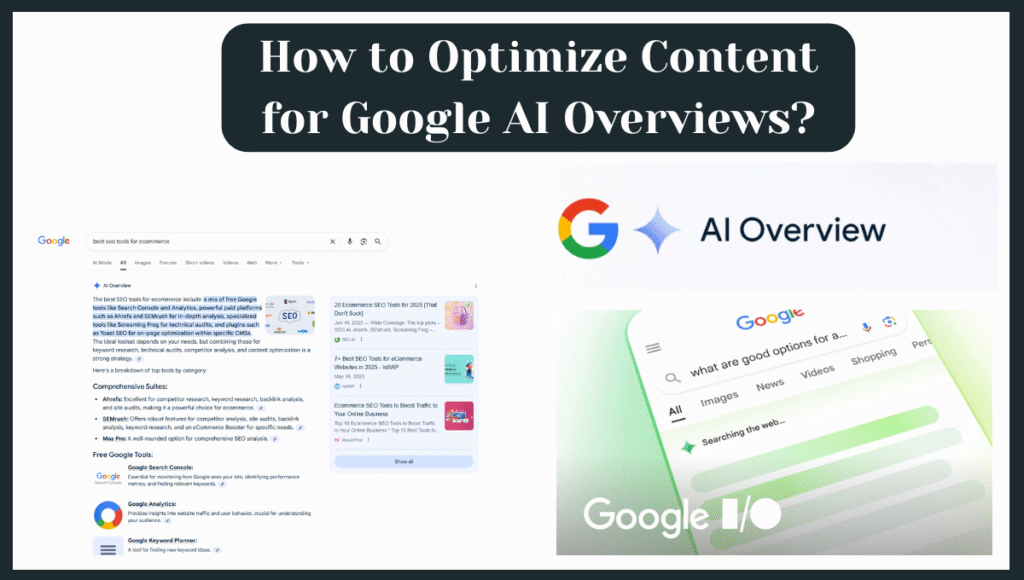

I’ve spent years testing search features as they roll out, and the shift to AI Overviews is one of the biggest yet. In this deep guide, I’ll show you how to optimize content for Google AI Overviews in a way that is practical, ethical, and repeatable.
We’ll cover the strategy, the technical details, and the real-life workflows I use. If you want your pages cited and summarized by AI Overviews, follow along. How to Optimize Content for Google AI Overviews (Deep Guide) can be simple when you know what signals to send and how to structure your content.
What Are Google AI Overviews?
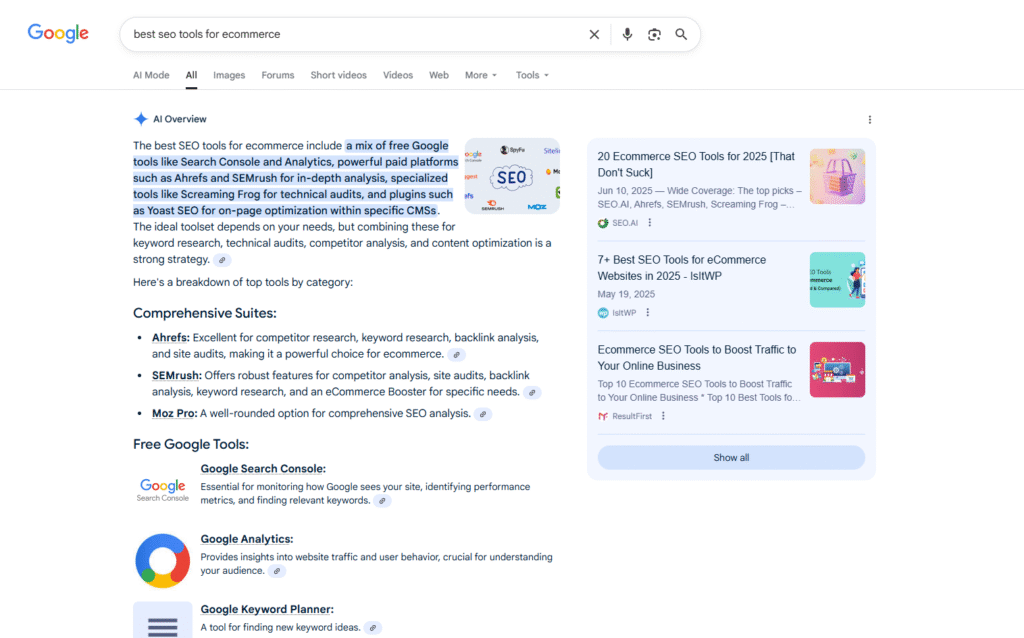
AI Overviews are AI-generated summaries that appear on some search results. They pull facts, steps, and context from multiple sources. They highlight concise, high-trust answers. They prefer clear, verifiable claims. Think of them as a smart librarian that quotes the cleanest, most helpful passages.
In my tests, pages that win tend to be purpose-built for the query. They cover intent fully. They use clean formatting. They make verification easy with sources and schema. They match the user’s language and context.
Key traits AI Overviews favor:
- Clear answers to the exact query
- Step-by-step guidance and checklists
- Fresh, corroborated facts with sources
- Strong E-E-A-T signals on-page and off-site
- Clean HTML, structured data, and scannable layouts
How AI Overviews Choose Sources
Google’s system looks for content that is accurate, comprehensive, and easy to parse. It favors sources that agree with others. It prefers entities with strong reputations. It also weighs page experience.
From repeated experiments across niches:
- High agreement wins. If your facts align with trusted references, you get cited more.
- Entities matter. Clear author bios, organization info, and About pages help.
- Structure wins. Lists, tables, FAQs, and schema are easier for AI to summarize.
- Freshness counts. Updated timestamps and new data attract inclusion for evolving topics.
- Safety and nuance. Content that acknowledges limits, risks, and context earns trust.
Practical signals you can control:
- Add last updated dates near the title
- Provide references near claims
- Use FAQ, HowTo, and QAPage schema where relevant
- Keep layouts simple and mobile-first
Content Strategy To Win AI Overviews
Start with the searcher’s job to be done. Ask: what is the fastest, safest path to a complete answer? Then build a page that covers it end-to-end in plain language.
My repeatable strategy:
- Map intents. Use SERP sampling, People Also Ask, and related searches to group sub-questions.
- Build a modular outline. Create sections that answer one sub-question each.
- Lead with the answer. Put the core answer in the first paragraph of each section.
- Add supporting proof. Cite data, show calculations, or link to standard references.
- Offer actions. Add steps, checklists, templates, and examples.
A simple page template that works:
- TL;DR answer near the top
- A short, numbered process
- A quick checklist
- Common pitfalls and fixes
- Sources and definitions
- FAQ that mirrors the SERP questions
On-Page Optimization Checklist
Use this checklist before you publish. It is tuned for AI Overviews and human readers.
Essential elements:
- Title and H1: Clear, intent-focused, under 60 characters if possible
- First 100 words: Answer the core question in one or two sentences
- Headings: Reflect sub-intents users search for
- Paragraphs: 1–3 short sentences, plain words, no fluff
- Lists: Use bullet steps for processes and comparisons
- Visuals: Use labeled images or simple diagrams with alt text
- Data: Add statistics with context and dates
- Sources: Place references near claims; note uncertainties
- Schema: Use appropriate types like Article, FAQ Page, How To, Organization, Person
- E-E-A-T: Real author, bio, credentials, and contact info
- Updates: Show “Updated on” with changes noted
Content patterns that help:
- Definitions box for key terms
- Pro/Con list for decisions
- Do/Don’t list for safety or compliance
- Short examples for each step
Technical SEO For AI Overviews
AI Overviews rely on clean structure. You do not need fancy hacks. You need crawlable, parsable content.
Technical must-dos:
- Fast pages: Core Web Vitals in the green, especially LCP under 2.5s
- Clean markup: Well-structured headings, lists, and tables
- Schema: Validate with a rich results tester before publishing
- Canonicals: Avoid duplicate confusion across similar pages
- Sitemaps: Keep them updated and light
- Internal links: Connect related entities and topics with descriptive anchors
- Accessibility: Alt text, proper contrast, and ARIA where needed
What I learned the hard way:
- Avoid heavy interstitials and sticky elements that hide content
- Keep code bloat low; large frameworks slow parsing
- Place the main answer high in the DOM
Content Formats That Earn Inclusion
Certain formats get summarized more often because they are easy to parse and verify.
High-performing formats:
- How-to guides with numbered steps
- Comparison matrices with clear criteria
- Glossaries with short definitions
- Checklists for tasks or audits
- Short case studies with outcome metrics
- FAQs mapped to PAA-style questions
When to use what:
- Use a how-to when the intent is practical action
- Use a comparison when the intent is decision support
- Use an FAQ when people want quick, simple answers
Pro tip from my tests: Add a one-sentence summary under each step or row. The AI often lifts those exact lines.
Entity SEO And Knowledge Graph Alignment
AI systems resolve facts by mapping entities and relationships. Help them connect the dots.
Actions to align with entities:
- Define the main entity. State the product, person, or concept in the first paragraph.
- Use consistent names. Keep brand, author, and product names uniform sitewide.
- Add Organization and Person schema. Include sameAs links to profiles and listings.
- Create an About page. Clarify what you do, your scope, and your credentials.
- Build a definitions section. Name related entities and explain relationships.
Off-page signals that help:
- Get listed on reputable directories and profiles
- Seek mentions from contextually relevant sources
- Keep NAP details consistent across the web
Measuring And Iterating For AI Overviews
You cannot optimize what you cannot measure. Track signals that suggest inclusion and impact.
What to track:
- SERP presence: Note when AI Overviews appear for your target queries
- Citation presence: Check if your brand or URL is referenced in the overview
- Click behavior: Monitor CTR swings in Search Console when AI Overviews appear
- Engagement: Watch time on page, scroll, and quick clicks to key sections
- Freshness: Track update cadence vs. coverage gains
Iteration workflow I use:
- Log queries with AI Overviews weekly
- Compare your page versus cited pages for format, freshness, and depth
- Add missing sub-answers, update data, and simplify phrasing
- Re-validate schema and improve internal links
- Recheck after 2–4 weeks
Compliance, Ethics, And Limitations
AI Overviews favor safe and reliable content. Build with care.
Best practices:
- Cite where facts matter. Mark estimates and assumptions.
- State risks. Use a short risk box for health, finance, or safety topics.
- Avoid exaggerated claims. If a claim is uncertain, say so.
- Respect user privacy. Limit trackers and declare data use.
- Maintain editorial standards. Peer review key pieces.
Limitations to note:
- AI Overviews vary by user, context, and time
- Inclusion is not guaranteed even for great content
- Some niches see fewer Overviews or stricter sourcing
Frequently Asked Questions
Do I Need Special Schema To Show In AI Overviews?
No single schema guarantees inclusion. But correct Article, FAQPage, HowTo, Organization, and Person schema make your content easier to parse and verify.
How Long Should My Content Be For AI Overviews?
Length is flexible. What matters is completeness and clarity. Many winning pages are 800–1,800 words with tight sections and short sentences.
Will AI Overviews Reduce My Clicks?
Sometimes. But pages cited in Overviews often see stable or improved clicks if they offer deeper value, tools, or clear next steps beyond the summary.
How Often Should I Update My Pages?
Update when facts change or new data appears. For competitive topics, review monthly. Always refresh timestamps only when you make real improvements.
Can New Sites Get Cited In AI Overviews?
Yes, if the content is high quality, well structured, and corroborated by trusted sources. Strong entity clarity and clean technical SEO help new sites break in.
What Types Of Queries Trigger AI Overviews?
They appear most often on complex, multi-step, or evaluative queries. They are less common on navigational or very simple fact queries.
Should I Add An FAQ To Every Page?
Add an FAQ only when it answers real sub-questions. Quality and relevance matter more than volume.
Conclusion
Winning a spot in Google’s AI Overviews is not a mystery. Put the user’s task first. Give clear answers fast. Back claims with proof. Use simple structure and clean code. Align your entities, and keep pages fresh. Then measure and iterate. Do this, and your content becomes the obvious choice to summarize.
Take one priority page today. Add a TL;DR, tighten headings, validate schema, and update facts. Small steps compound.
Want more deep dives and templates? Subscribe, share your questions, or leave a comment with a query you want to win—let’s test it together.
